
GLP-1 Dinner Party Decoder: Guest and Host Survival Guide
Someone's home, someone's cooking and a smaller appetite than the menu expects. Here's how to be a gracious GLP-1 guest, and how to host one without making it weird.
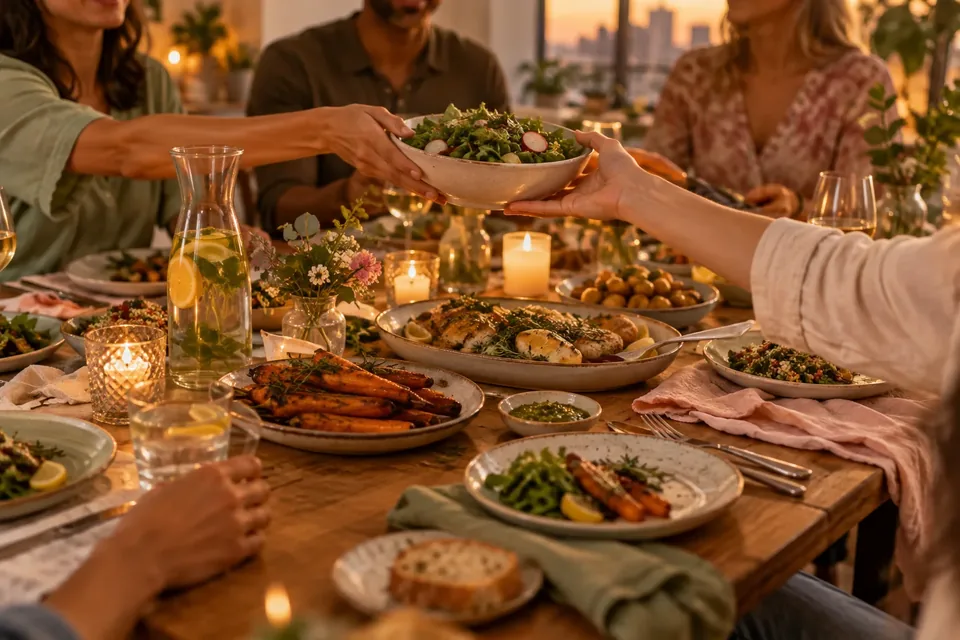
A dinner party on a GLP-1 can feel trickier than a restaurant. At a restaurant, nobody's feelings are on the plate. At someone's home, the person who cooked is watching you eat. Good news: a few scripts, a smaller first plate and one well-placed compliment cover almost every situation. And if you're the host with a GLP-1 friend coming over, there's a short section for you too.
This is about the social side of dinner at someone's home. For restaurants, see our scripts for eating out with friends. For big family holidays, see holiday meals and boundaries.
Why dinner parties feel harder on a GLP-1
Three things collide at a home dinner:
- Hospitality is measured in food. Seconds, thirds and "you have to try the dessert" are how many hosts show love.
- Your appetite may be smaller than it used to be, and you may notice fullness sooner.
- Courses keep coming. Appetizers, mains, dessert, cheese. A menu built for the old you.
There's also a comfort reason to pace yourself. A 2025 joint advisory from four nutrition and obesity medicine societies notes that vomiting is more likely after large meals. It suggests smaller meals and limiting large or high-fat ones when the stomach is unsettled. It also says to keep alcohol to a minimum, since it can make nausea and reflux worse. None of that means you can't enjoy the evening. It just means "pace yourself" is practical advice, not a diet slogan.
The dinner party decoder: what they say, what they mean, what you can say
| What the host says | What it usually means | A reply that works |
|---|---|---|
| "You barely touched it!" | "Did you like my cooking?" | "I loved it. The sauce is incredible. I'm just full fast these days." |
| "Have some more!" | "I made a lot and I'm proud of it." | "I'd love to take a little home, if you have extra." |
| "Are you on a diet?" | Curiosity, sometimes nosiness | "Nope, just pacing myself tonight. What's in this, by the way?" |
| "Is it that shot everyone's on?" | They've read the headlines | "It's something I'm working on with my doctor. Anyway, how was the trip?" |
| "You have to try dessert." | "I've been waiting all night to show you this." | "Can I have a tiny slice? I want to taste it properly." |
| "One more glass?" | Pure hospitality | "I'm on sparkling water, but cheers to you!" |
The move in almost every row: compliment first, decline second, change the subject third. A specific compliment ("the crispy edges on these potatoes!") tells the host the food landed, so the size of your plate stops being a review.
You never owe anyone a medical explanation. If you want help deciding what to share and with whom, see how to tell family or coworkers, if you want to.
Being a great guest with a smaller appetite
Eat a little before, if long gaps don't suit you. Dinner at 8:30 after a 1 p.m. lunch can backfire. A small snack can keep you from arriving starving and overdoing the bread basket.
Plate small on the first pass. With family-style service you control the portion. Take a little of several dishes and go back for the one you love. A second trip looks like enthusiasm, not restraint.
Start with the protein. The 2025 advisory notes that protein-rich foods can be eaten first in a meal. With a smaller appetite, that order helps the most filling, most useful part of the plate get eaten before you're full.
Slow down on purpose. Put your fork down when you talk. You're there for the company anyway.
Ask for leftovers instead of seconds. Most hosts love sending food home. It turns "I can't finish this" into "I want more of this later." Keep the leftovers safe: FDA says perishable food, take-home containers included, shouldn't sit at room temperature for more than two hours, or one hour if it's above 90°F.
Bring something you know works for you. A big salad with a protein, a vegetable side or a fun non-alcoholic drink is a generous contribution. It also guarantees there's something you're comfortable eating. Our non-alcoholic drinks guide has ideas.
Know your exit line. If you start feeling unwell, "I'm going to call it an early night, this was wonderful" is all anyone needs to hear.
Hosting a guest who's on a GLP-1 (or anyone with a small appetite)
You don't need a special menu, and please don't announce one. A few quiet choices make the evening easier for every guest, not just one:
- Serve family-style or buffet-style so everyone builds their own plate. FDA's party food advice suggests several small platters rather than one huge one, and swapping in fresh dishes as the night goes on.
- Include a clear protein and a vegetable dish that aren't swimming in cream or deep-fried. Rich dishes are great. Just don't make them the only option.
- Offer good non-alcoholic drinks, not just tap water. Sparkling water with citrus or a nice iced tea in a real glass.
- Drop the clean-plate energy. No comments on who ate what, no "you didn't like it?" Let portion sizes be invisible.
- Make dessert small or shareable. Mini portions, a fruit plate or a cake people can slice themselves.
- Have containers ready so leftovers are an easy, natural offer. Then follow the two-hour rule for anything perishable.
- Keep the conversation off bodies. Not "you look great, what's your secret?" Not "should you be eating that?" Just talk about anything else.
If a guest chooses to tell you about their treatment, the best host reply is simple: "Thanks for telling me. Anything you'd like me to have on hand?"
When it's more than a small appetite
Feeling full sooner is common. Feeling unable to eat or drink enough isn't something to push through for the sake of a party. If you keep vomiting, can't keep fluids down or have severe stomach pain, contact your prescriber. Severe, persistent belly pain needs urgent care. Our guide to vomiting on a GLP-1 lists the warning signs.
It can also help to notice patterns. If rich party meals often leave you uncomfortable, jot it down. A quick note in a symptom log, like the one in GLPily, makes it easier to spot which meals sit well and to tell your clinician what's actually happening.
Common questions
Is it rude to leave food on my plate at a dinner party?
Not if you pair it with genuine appreciation. A specific compliment and a request to take some home will make most hosts happier than a clean plate would.
Should I tell the host ahead of time that I'm on a GLP-1?
Only if you want to. "I've got a small appetite these days, so don't be offended if I eat light" works without any medical detail.
Can I drink alcohol at a dinner party on a GLP-1?
Ask your prescriber what's sensible for you. The 2025 nutrition advisory suggests keeping alcohol to a minimum because it can worsen nausea and reflux. A non-alcoholic option in a nice glass keeps you in every toast.
How do I host someone on a GLP-1 without singling them out?
Make choices that help everyone, like family-style serving, a lean protein, non-alcoholic drinks and leftover containers, and never comment on what anyone eats.
Sources and further reading
This article is general education, not medical advice, and hasn’t replaced a conversation with your prescriber. Never change, skip or stop a medicine based on an article or an app. If you have severe or worrying symptoms, get medical help. Written by the GLPily Editorial Team from the sources listed above.
Make your GLP-1 journey easier to track 💚
Keep your shots, weight, food, water and symptom notes together with GLPily, and meet Pily, the little coach who answers from your own logs.


- Shot tracking
- Water & symptoms
- Weight trends
- Journal
- Food scanner
- Progress photos